Memphis sits in the Mississippi River delta plain where annual precipitation averages 53 inches and summer relative humidity consistently exceeds 70 percent. These local climate conditions force ground moisture…
Memphis sits in the Mississippi River delta plain where annual precipitation averages 53 inches and summer relative humidity consistently exceeds 70 percent. These local climate conditions force ground moisture directly into unsealed sub-floors through capillary action in Shelby County's silty loam and clay soils. In historic raised-foundation homes throughout Midtown, Cooper-Young, and Central Gardens, open brick vents draw in dense summer air that condenses against floor joists cooled by interior air conditioning. When structural timber sustains moisture content above 19 percent, it invites subterranean termite colonies (*Reticulitermes flavipes*) and wood-decay fungi. Unsealed crawl spaces allow soil gases and insect pheromone trails to draft upward into living spaces through the stack effect, carrying damp odors and allergen-bearing pest particles.
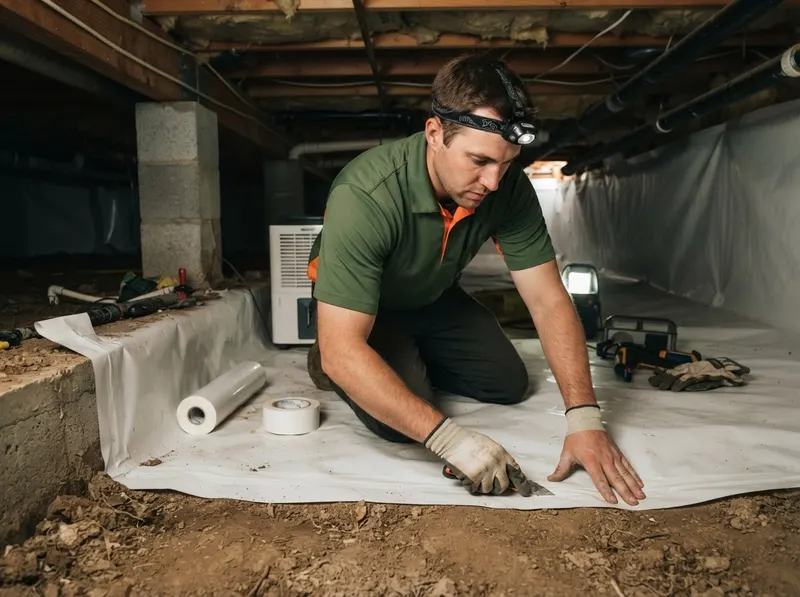
A complete encapsulation barrier systematically interrupts this biological cycle. The field protocol involves clearing residual organic matter, grading standing soil, and anchoring heavy-gauge polyethylene membranes across 100 percent of the earth floor, extending up the interior foundation walls while preserving a mandatory 3-inch termite inspection gap below the sill plate. In East Memphis and Highpoint Terrace crawl spaces, loose fiberglass insulation commonly absorbs ambient humidity, collapses under its own weight, and forms nesting beds for oriental roaches and rodents. Encapsulating the envelope replaces wet batt insulation with rigid foam along the masonry perimeter, locking relative humidity below 55 percent to arrest fungal growth entirely.
Selecting between passive vapor barriers and complete closed encapsulation depends directly on existing foundation architecture and sub-floor grading. A basic 6-mil poly ground cover laid loose over soil costs less initially, yet it allows atmospheric humidity to circulate freely through perimeter vents, providing inadequate defense for homes with recurring subterranean termite activity or cupping hardwood floors in Binghampton and Cordova. Full sealed encapsulation with a dedicated low-temperature commercial dehumidifier isolates the entire crawl volume from external weather swings. The physical trade-off involves dedicating continuous electrical power, typically drawing between 4.5 and 7.0 amps during peak dehumidifier cycles, in exchange for halting timber rot and neutralizing the sub-surface moisture paths that Delta pests require to survive.
Every job gets a firm, written price after a free on-site visit.
Tell us about your crawl space encapsulation moisture defense job in Memphis and we'll send a clear, written quote, usually the same day.
 BugBlocker Pest Control